The Stalemate
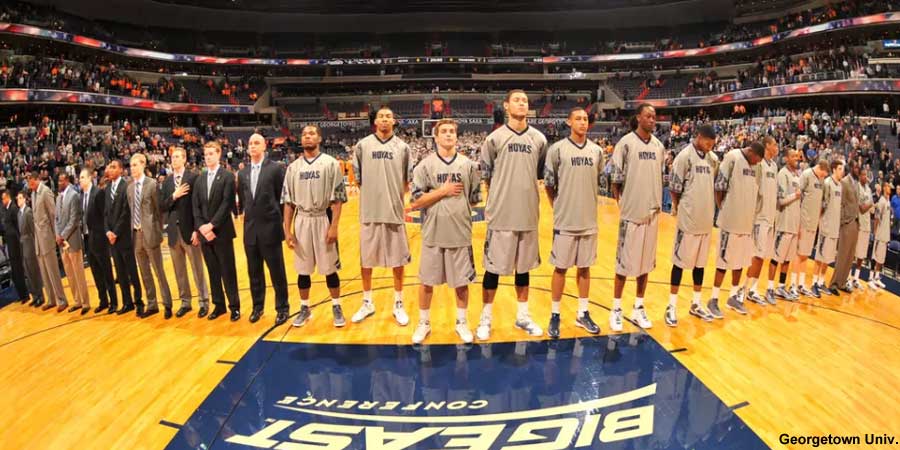
In the wake of a 56-50 win by DePaul which saw the Georgetown Hoyas go over ten minutes (twice) without a field goal, online commenters remarked that they had never seen anything like this game. For some of us, it harkened back to a Friday evening in Washington 13 years ago.
On November 30, 2012, a rush-hour crowd of 13,656 arrived at Verizon Center for an early season meeting between a pair of 4-1 teams in the Big East-SEC challenge series: #20 Georgetown versus Tennessee. Georgetown was underrated nationally, with its only setback an overtime loss to #1 Indiana at the Barclays Center the week before. The two teams were each allowing only 63.2 points through its first five games, so a tight defensive game was not unexpected.
No one expected what followed.
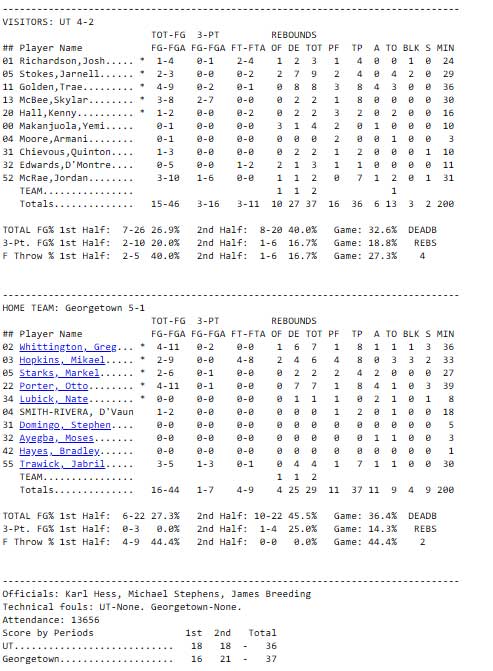
Slow starts were nothing new for either team, but by the first media timeout both had little to show for it: Georgetown led 4-2. By the midway point of the half, the Volunteers missed 10 of its first 12 shots, Georgetown six of 11, where a layup from Jabril Trawick extended the Hoyas lead to 12-4 with 10:13 to halftime.
From the game recap: "With 10:10 to play, Georgetown led by the modest score of 12-6 on 54 percent (6-11) shooting. Over the next ten minutes, the Verizon Center crowd and the ESPN audience were witness to an offensive stalemate unseen in the shot clock era of Georgetown basketball.
To its credit, Tennessee displayed a stout defense, particularly with Josh Richardson's effort against Otto Porter, holding him to four points in each half. But Richardson alone couldn't have done it alone, as the Hoyas did not make a field goal for the final 10:10 of the half.
A missed three by Greg Whittington. Three consecutive missed jumpers from Otto Porter, Greg Whittington, and Mikael Hopkins. A missed layup from Markel Starks. A missed three from Porter. A missed layup from Hopkins, who struggled inside all day.
By the time Starks missed a jumper with 4:42 in the half, the score was only 12-9, as the Volunteers had shot a woeful 1-5 with three turnovers. The Hoyas managed only one field goal attempt for the rest of the half, as a parade to the free throw line managed only four points in seven attempts. Tennessee didn't climb into double digits until the 4:24 mark, and still trailed by five with 2:08 in the first half before scoring on back to back possessions to tie the score, taking the lead with a put-back basket at the buzzer, 18-16. Georgetown ended the half shooting 27 percent overall, 0 for 3 from three point range."
Together, the two teams had shot 13 for 48 (.270), 2 for 15 for three (.133), and forced nine turnovers between them. This wasn't a function of simply bad shots, but smothering defenses which had locked each possession into a war of attrition. Fans at halftime wondered who would lift each team out of the defensive fog which had enveloped the baskets.
From the recap: "The Hoyas appeared to have taken Coach Thompson's adjustments to heart, opening with a 11-2 run in the first five minutes to lead by as many as seven, 27-20. Jabril Trawick's three pointer at the 15:00 mark was Georgetown's only three of the game and with it, both teams reverted to the stalemate of the first half. GU pushed the lead to eight, 31-23, at the 12:10 mark, but the Vols outscored the Hoyas 9-0 over the next four minutes to regain the lead, 32-31.
Georgetown got a layup from Porter to regain the momentum, but missed its next three. In a key sequence of the game, Tennessee was sent to the line and missed four consecutive free throws that could have broken the game open. With 5:57 remaining, the Vols' Kenny Hall put UT up one, answered by Whittington at the 5:00 mark, 35-34. The teams traded jumpers to keep the count at one with 4:10 to play, 37-36."
The stalemate was on.
Tennessee guard Trae Golden missed a jumper at the 3:43 mark, but Georgetown's Mikael Hopkins lost it 12 seconds later. UT's Kenny Hall lost the ball out of a media time out, but Whittington missed a layup. Otto Porter stole a pass from Hall with 2:52 remaining, but missed a layup. Off an offensive rebound from Porter's miss, the Hoyas regrouped. Open in the paint, Hopkins missed an jumper.
Inn its next series, guard Skylar McBee was picked off by Whittington, but Trawick lost the ball out of bounds with 1:18 left, still 37-36.
A Jarnell Stokes jumper was wide for the Vols, whereupon GU breathed an early sigh of relief and called a timeout to plan running out the clock or at least getting to the foul the line, where they had not attempted a shot in the second half.
There was no foul shot, because Porter lost the ball out of bounds with 18 seconds left, its third turnover in the last five possessions. Another Tennessee time out followed with 21 seconds left. With nothing inside, and five seconds remaining, McBee sent up a three with five seconds remaining, but the Hoyas lost the ball out of bounds. On the in-ball, McBee was alone but we;; out of the play. With Markel Starks hugging the passing lane, the inbound pass went outside to an wide open McRae for the game winner with two seconds left. His shot rolled tantalizingly past the rim.
Final: 37-36.
Post-game reports ranged from annoyed to amazed. The Associated Press called it "an offensive display of offensive basketball." ESPN went so far as to devote its entire nightly "Not Top 10 List" to highlights from this game.
"That was the ugliest game I have ever been a part of on any level," said coach John Thompson III.
"Tennessee's defense did what it does: the Hoyas shot 36.4% and scored just 37 points," wrote a post-game recap at SB Nation's Rocky Top Talk. "And Georgetown's 6'8" gauntlet did what it does: the Vols shot 32.6% and turned the ball over a dozen times. The Hoyas made it their business to take Jarnell Stokes away, and business was good: Stokes had more turnovers (four) than shot attempts (three), and only got to the line once...where he missed both.
If Thompson saw a need to adjust his defense-first policy, he chose not to.
"I don't think we needed to make that many adjustments," he said., "so then we came out and did the exact same thing in the second half."
One bystander that approved? Hall of Fame coach Bob Knight, the analyst on the game.
"I'll tell you what Georgetown did [on that last shot], they did a really, really good job of getting [the pass] into [McRae], he was going to be the guy that takes the shot. Watch him carefully, everybody that had a chance to shoot it was going to be under pressure, this is just a very difficult shot right here. Good pressure, no foul."
"This happened twice, they did a great job of not fouling two different shots."
Knight's point about the foul situation was spot-on: Georgetown committed one foul in the final 3:47 of the game, and would win or lose the game on defense, not foul shots.
In another view, however, foul shots were the story: Georgetown took no foul shots in the second half and finished just 4 for 9. Tennessee was 1 of 6 from the line after halftime and finished 3 for 11.
"In a game like this there's lots of yuck to go around, and Tennessee's performance at the stripe...is at or near the top of that list," read the SB Nation recap. "The Vols missed almost three-fourths of their free throws and lost by one point."
Three Georgetown players led the stat sheet with eight points. It was the first game since January 12, 1952 where its leading scorer was in single digits.
"As frustrating as an offensive day that I can remember being a part of, we still got stops," Thompson said. "And that's not the worst thing in the world."
The game served as a case study of sorts about recent trends in the game which were bringing the offensive output down. Some coaches took notice, some did not.
In the following year's Athlon preview issue, columnist Michael Bradley wrote: "Coaches all over agree that skill development suffers as the AAU wave washes across the teenage basketball community. Its impact , along with a collection of other factors, has led to a historic drop in offensive effectiveness throughout the college game. "Last season, teams averaged a meager 67.5 points per game, the lowest since 1951-52. Three-point shooters succeeded at a 34.05 percent clip, the worst since the shot was introduced in 1986-87. Assists (12.82 per game) reached a 20-year low. And fans were subjected to some games that made them run, screaming, to the box office for refunds. The halftime score of the Miami-Maryland game was 19-14. Arkansas and Vanderbilt were in a 21-11 tussle at intermission of their game. And how about this final score: Georgetown 37, Tennessee 36.
"The skill level of [today's] players is really low," Villanova coach Jay Wright says. "You have to work on skills, footwork and shooting technique before you can teach a player your system. No system is effective without fundamentals."
Wright's quote was prescient. Entering the 2013-14 season, Wright had recovered from a 13-19 season in 2012 that had raised concerns about a possible coaching change, and he finished 20-14. Instead of focusing on the grind-it-out, get-to-the-foul-line style which had been frequent in his first decade on the Main Line, Wright had begin to assemble a group of players that were fundamentally strong and more adept at passing than any other Big East school.
The year before, he had recruited Ryan Arcidiacono, the son of Villanova parents who was a scorer-first, passer second in high school. before Wright began to build his motion offense,and Arcidiacono averaged nearly 12 points and 3.5 assists per game as a freshman. A pair of D.C. players overlooked by Georgetown, 6-5 Josh Hart and 6-6 Kris Jenkins, would be added this season and quickly earn starting roles.
Over the next four seasons, the Wildcats were a combined 129-17 (.883), with four Big East regular season titles, two Big East tournament titles and the 2016 national championship, a game which saw Arcidiacono, a natural shooter, drive the ball with seconds left, but instead passed to a trailing Jenkins for the game winning shot. The game had changed.
Over the next four seasons, the Hoyas were a combined 69-62 (.526). John Thompson III was fired at the end of the 2016-17 season.