Revisiting The Reserves
It was over 20 years ago that, en route to the Georgetown-Davidson football game, I stopped for the evening in Chapel Hill. The North Carolina men's team was hosting an exhibition game that evening, but I didn't have a ticket and was left walking around the Dean Smith Center to get a peak before the game.
Suddenly a man opened a locked glass door. "Anyone here want to see the JV game?" he asked.
"Uh, sure," I responded.
Maybe he didn't notice the blue Georgetown "G" cap I was wearing, or perhaps he confused it with Division III Greensboro College, the opponent in the first game that evening. Either way, I walked in without so much as a ticket and found my way to an aisle seat in the fifth row behind the press table, with a hundred or so other friends and family watching the game scattered amidst 21,000 empty seats.
This was the North Carolina junior varsity team, dressed in the same jerseys as their varsity teammates and playing its games on the same floor as the preliminary to the evening exhibition. An entirely nonscholarship outfit, it has a special place in that school's basketball history, which we'll discuss later.
With such a small turnout, the 21,750 seat arena was quiet as far as the game itself, allowing time to view the game, hear the play-calling, and experience the grandeur of the House That Dean Built: the retired jerseys, the championship banners. At the conclusion of the game, suddenly thousands of people began to pour into the arena, literally running down from the steps of the concourse for first come, first served seating--for some of these people, it was their only chance to see the Tar Heels in person all season. Knowing a good thing when I saw it, I promptly stayed anchored in my seat as I was joined by a near sold out crowd for the varsity exhibition versus Division II Mount Olive College, with a once in a generation view of the game.
Fifteen minutes later, led with a slow, methodical drum beat from the band, fans were ready to welcome the Tar Heels as they would be for a Duke, NC State, or anyone else that arrived at a home game. Seeing it up front was impressive.
All these years later, the memories aren't of the 100-68 win over Mount Olive by a team that would go on to win the 2005 NCAA championship. Instead, it was the contrast of watching those 12 junior varsity players, to whom games like theirs was as memorable as that of their scholarship classmates.
North Carolina is the only major Division I program with a junior varsity. Once upon a time, Georgetown had one as well.
From 1926 through 1972, the NCAA held freshmen ineligible from competition, regardless of scholarship status. As a means of providing training and competitive opportunities for its scholarship freshmen, college teams began developing separate teams which would compete. As the number of scholarship players rarely exceeded four of five in a class, try-outs were held among freshmen for the remaining players. With a mix of opponents ranging from high schools to fellow JV units, Georgetown freshman basketball, colloquially referred to in the press as the "Baby Hoyas", was a part of campus life for three generations.
When these freshman teams finished .500 or so, and they did, that could often be a sign of struggles ahead when the scholarship players moved up. Then again, a memorable season foretold good times to come.
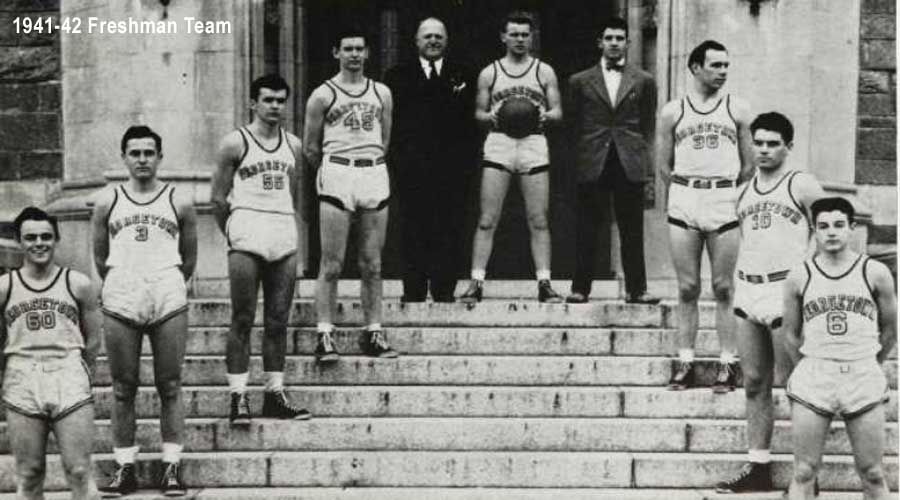
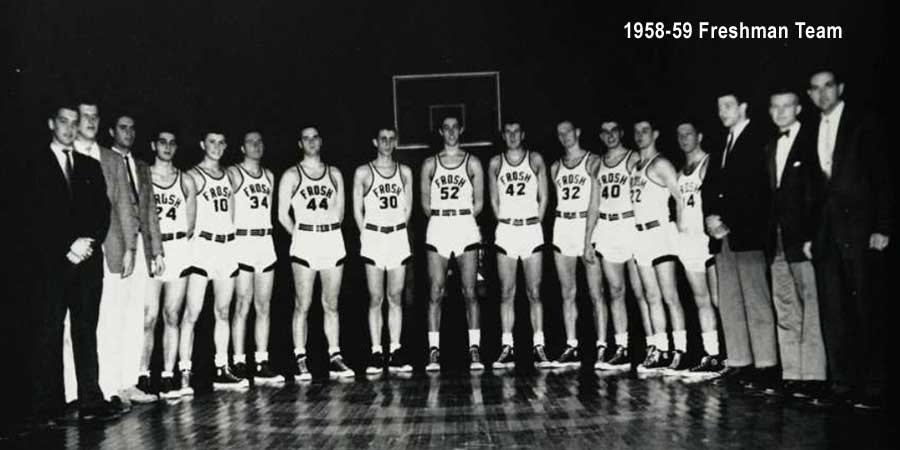
The 1941-42 freshman team won 18 of its 19 games by an average of 32 points per game, with its only loss to a military unit comprised of former pro players. A year later, this group carried Georgetown to the Final Four. Georgetown's 1953 NIT team was built on the shoulders of its 1949-50 freshman team which finished 16-1. The Class of 1962 remembers its 1958-59 freshman team, which despite a loss to John Thompson and the undefeated Lions of Archbishop Carroll HS, finished 16-4 behind the likes of Paul Tagliabue, Bob Sharpenter and Jim Carrino.
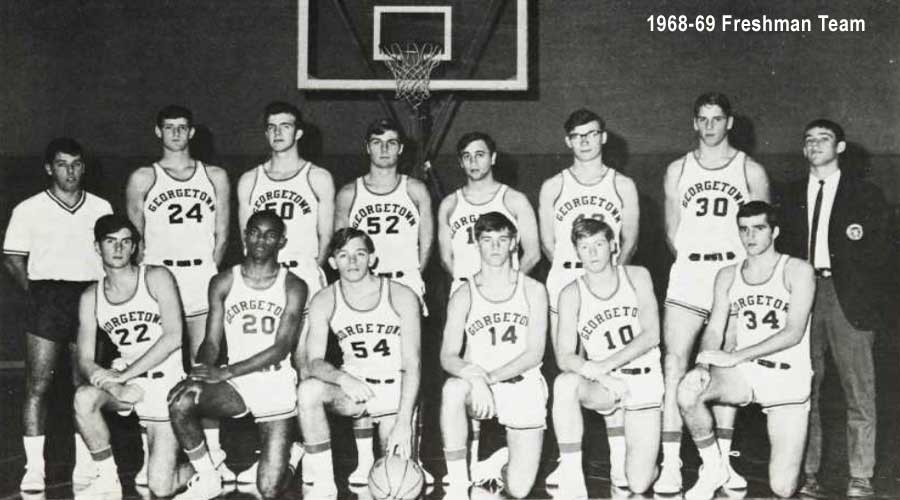
A decade later, seeds for the 1970 NIT were planted with its freshman team, which not only featured the likes of Mike Laughna, Mark Mitchell, and Art White, but also reserves like Bob Beagan, Kevin O'Donnell, Pete Ramey, and Bruce Mason, a 6-2 physics major who played three sports. None of these walk-ons moved up to the varsity, but carried a lifetime of memories from those games.
Following 1972, the Georgetown freshman team became known as the junior varsity or the reserve team, extending beyond freshman players but with fewer games and fewer players making the move to the varsity.
"The team lacks a dominant big man and a point guard. We have good shooters, but lack the experience to win," said junior Mike Kelly to The HOYA in 1975.
By the turn of the 1980s, the program was not well known at all.
"Georgetown basketball, that's Coach John Thompson's team, the Heart Attack Hoyas. You've heard of Floyd, Frazier, Smith, Brown, Hancock, Bullis, and the rest of the guys, haven't you?" asked the Georgetown Voice in 1981. "That's also Coach Craig Esherick's team, the Heart Attack Hoyas Reserves. You haven't heard of Sal Vitiello, Chris O'Meara, Fred Keefe, John Clyne and Dennis Joyce, have you?"
The program "provides an opportunity for non-scholarship players to compete on an organized level of basketball beyond that of intramurals," Esherick told the Voice. "Reserve teams usually don't have the height of the varsity, so the competition is more evenly balanced. We play a passing game, taking time to go for the shot. These guys have hustled all season at both ends of the court. They never give up, they're a real group of fighters."
Unfortunately, the team was quietly decommissioned after the 1980-81 season. With its demise, there was no way a student could realistically work his way onto the team. Walk-ons were now recruited to Georgetown in advance, and the often secretive nature of the Thompson era dissuaded players outside the program's watchful eyes. Occasional promises of walk-on tryouts never yielded selections beyond a practice-only player, if that.
Last season's Georgetown team carried four walk-ons, its most since the 1960s, with three of the four seeing action in the injury-depleted College Basketball Crown. Upcoming changes to NCAA bylaws, however, may limit GU's ability to carry any walk-ons on teams including men's basketball. As part of the House v. NCAA settlement, schools will maintain a roster cap of not more than 15 players. For some teams, there may not be room to add students as walk-ons.
Adding walk-ons each year at North Carolina isn't a hope, it's an expectation.
The structure of the UNC junior varsity program is a direct result of the strategy of former coach Dean Smith. He saw JV teams as not only as an opportunity for students, but as a learning opportunity for his coaching staff.
"Coach Smith always thought that everybody that comes to the university should have a chance to try out for the basketball team," said former coach Roy Williams in a 2012 NPR intereview. "For me it's something that I want to continue doing. I saw my own son go through the program. I've known kids that have gone through the program that still speak so highly of that whole experience."
The junior varsity team is traditionally coached by the junior member of the UNC assistant coaches. Smith saw the role as a opportunity to learn in-game coaching first hand, and the likes of Roy Williams, Doug Wojcik, Jerod Haase, and Hubert Davis all took their turns coaching the JV. Further, to maintain the quality of the team, Smith provided a tantalizing offer to UNC students. Each season, one player would be elevated to the varsity roster the following season.
In 2020, the New York Times told the story of a three year JV player named Robbie O'Han.
"In September, O'Han got an irresistible offer to move up the chain from Hubert Davis, an assistant coach with the Tar Heels. The main team was down to one healthy point guard, Cole Anthony, and needed another before the season started in November. "I was going to have three weeks to practice with the team and then they were going to decide if they wanted me to stay on the team or go back down to J.V. And they decided to keep me."
"When I was in high school, I was getting looked at by mainly DII and DIII schools," he said. "I grew up in Raleigh, so I knew about the JV program at UNC and I knew some guys who had gone through it. From what I heard, it was a tryout and any college student could go and try out. So I chose to go to UNC instead of playing basketball elsewhere, just as a general college student."
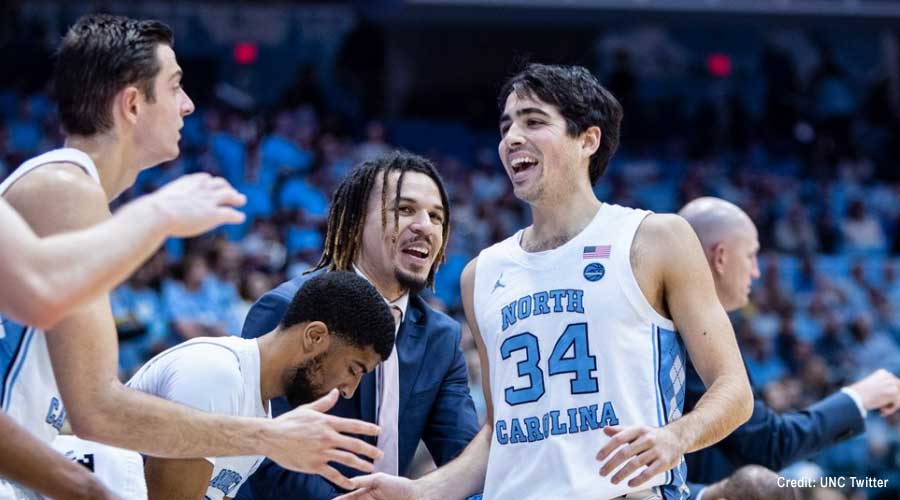
Robbie O'Han played in 12 minutes over 12 games his senior season, wearing the same $34 jersey number as Bobby Jones, J.R. Reid and George Lynch did. Today, he's an investment banker, not a pro athlete, but players like him are legendary in Chapel Hill, because for every incoming freshman at North Carolina with a good jump shot and a lot of desire, they could be wearing that jersey someday.
In a world of increasing professionalism in college basketball, that's a story worth telling. Maybe even at Georgetown.
What would it take to revive junior varsity basketball at Georgetown? Commitment, for one.
The fixed costs for a junior varsity program, even one at a limited level, need University support. To control costs, North Carolina's team plays all its games at home--for Georgetown, that's likely to be McDonough Gymnasium and not Capital One Arena, perhaps as the opener to a women's basketball game. Scheduling becomes an issue, though there are enough prep schools and Division III schools in the Washington region (Catholic, Marymount, St. Mary's, Salisbury, etc.) that could make it work.
Building a team would take skills as well. The intramural ranks may have its share of players and a club basketball teams exists on the periphery, but a Georgetown JV team playing established programs is a considerable step above Court 1 at Yates Field House, and no one wants to see a team be set up for failure. Would the opportunity to compete for a spot on the Hoyas' main roster raise the bar for students?
Even at a school like North Carolina, JV games are sparsely attended and awareness is low, so it's not about selling tickets. Competition, not championships, is an intangible that speaks to what Georgetown Athletics is all about, but it is in conflict during an era where less participation, not more, is seen as a strategy by many cash-strapped athletic departments.
So why make the investment?
Ask Russell Hawkins, a business major from Charlotte who was called into the head coach's office last season. A JV player and second generation Tar Heel whose mother was a cheerleader in her days at Carolina, Hawkins was offered an opportunity to join the varsity that speaks to students playing a student's game. He was issued the #14 jersey.
"Sometimes, I come in here and I shoot, and I sit down and just look around like, wow, I can't believe I'm here," Hawkins said at the pre-season media day at the Smith Center. "These championships, these great players, these names up there [in the rafters]. I'm a part of it now," he said. "I made it."