On January 12, 1974, ABC television debuted a mid-season replacement called "Happy Days", a pilot that had been rejected three years earlier as a comedy starring Ron Howard titled "New Family in Town". Within six months, the show became a hit. Set roughly 20 years in the past, the show's mid-1950's motif rode the wave of national nostalgia that was overtaking 1970s America, a yearning for simpler times without the upheaval endured in recent years.
Psychology holds that nostalgia is not a longing for what exists, but for what we longer have. A baseball fan is not nostalgic about Dodger Stadium because it is still here; however, fans of a certain age remain nostalgic about Ebbets Field precisely because it is not longer with us and not to return. By its nature, nostalgia (a word whose Greek etymology literally suggests "the pain of returning") evokes a certain sadness.
It's been 20 years since Georgetown met #1 Duke at MCI Center, a game that set the men's basketball program at Georgetown on a two year run to the top of the sport. It came as a redemption of sorts for a program that had endured, to that era, anyway, hard times: an unprecedented 13-15 season in 2004, a change of coaches, and no NCAA bid over four years. In looking back on the game recap, there was little of nostalgia and more of the here-and-now: sheer, unbridled optimism and a mandate to look forward, two conditions all but gone from the increasingly disconnected fan base for this program. For one Saturday afternoon in 2006, it was a like a giant bottle rocket had been shot into the Northwest DC skyline.
Comments flowed from what was still a pre-Twitter media landscape:
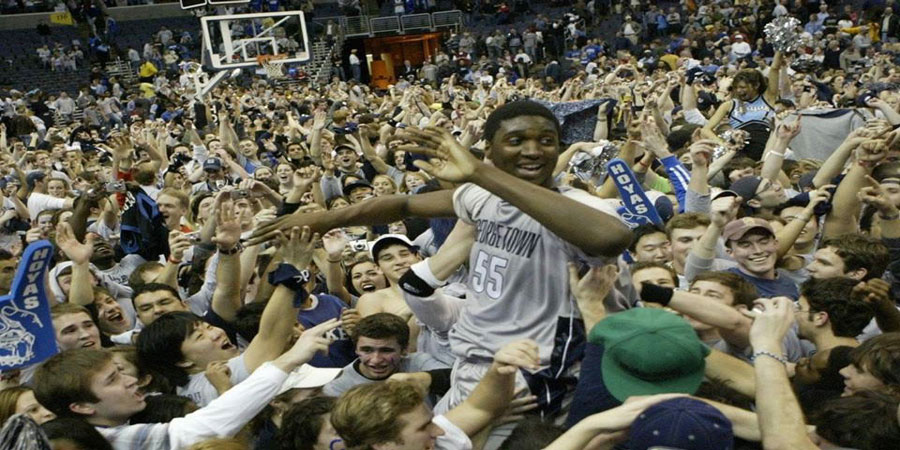
"In the giddy moments after the game, the student sections behind each basket looked like a disaster zone, with toppled chairs and squashed cups," wrote Camille Powell at the Washington Post. "The arena floor was mobbed with dancing and screaming students. Redshirt forward Patrick Ewing Jr. picked up Cook, whose legs were cramping, and carried him through the crowd. Bowman stood on top of the scorer's table and screamed, and then appeared to stop and to hug every fan he came across as he walked off the floor."
"Clean-up crews at the MCI Center already had their hands full all afternoon, trying to prepare the building for a hockey game just a few hours after it had played host to a basketball game," wrote Brian Strickland of the Durham Herald-Sun. "But thanks to what had happened earlier in the afternoon, workers' hands also were filled with broken folding chairs, cell phones headed for the lost-and-found and piles of debris on the hardwood itself -- all telltale signs of a Duke loss away from home."
"Let's see, Georgetown knocks off the No. 1 team in the country. St. John's beats two ranked foes in the span of five days. Break out the Miami Vice shades and the Wham cassettes, baby -- it's 1985 all over again," said Stewart Mandel at Sports Illustrated.
"Georgetown has a history of being tough on devils and on Saturday its team exorcised the Duke Blue Devils, casting them from the ranks of the undefeated," wrote Ned Barnett at the Raleigh News & Observer. "Near the end of Duke's first defeat, a Georgetown student held up a sign declaring: "God is on our side." God made no postgame comment."
And from the Duke Basketball Report:
"One of the things Duke fans don't get to do anymore, and really haven't been able to do since 1991, is to thoroughly enjoy the role of underdogs. Don't get us wrong, it's better to win than for winning to be a surprise. But when you see the joy at a Georgetown, or a Virginia Tech, or whoever it happens to be who knocks Duke off, it's hard not to appreciate it and to be happy for that team. And we are sincerely happy for Georgetown and especially for Coach Thompson, a young coach who we have followed since he turned in a very impressive stint at Princeton. It's his biggest win so far, but it's not going to be his last one."
A photo from that day graces the cover of this site. I sometimes look at the faces in this photo, a moment in time. Where are they today?
One of the earliest contributions to this history site comes from a 2007 commentary titled "Team Moderate Temperature", by John Hawkes, a 2004 SFS grad who followed the story of a group of undergraduates who slept outside MCI Center the night before the game. It tells the story not only of the students, who are now in their early 40s, but the pulse of a fan base no longer present. In it, he wrote:
"What basketball does for the Georgetown campus at its best is bring students of all backgrounds, interests, and social circles together for one common purpose. A successful basketball team brings ever more people into the fold, and that can only be a good thing for the University as a whole. The significance of the Duke victory is that it created, in the words of Michael R. Segner, a "watershed moment of self-realization and pride, not just about our basketball team but the greatness of Georgetown as a whole"... The continuing relevance of the Duke victory today is that nearly every student on campus is more likely to believe that such a moment can always be waiting at the next game."
J.J. Redick, now the head coach at the NBA's Los Angeles Lakers, still remembers.
I reached out twice to John Hawkes for him to provide a look back at this moment, 20 years later. No response. He checked out of Georgetown basketball, like most of his contemporaries -- pushed out, gave up, or simply ignored. I thought of these faces in the photo, many approaching their 20th reunion year, as Georgetown battled #3 Connecticut to a 64-62 loss this past weekend. Were they watching? Do they care anymore?
Twenty years later, the Duke game is remembered as much for nostalgia than for continuing success, and it's likely today's students will never get such an experience at a Georgetown basketball game.
There are no bottle rockets anymore at Georgetown. But for that one afternoon, the sky was the limit.
Psychology holds that nostalgia is not a longing for what exists, but for what we longer have. A baseball fan is not nostalgic about Dodger Stadium because it is still here; however, fans of a certain age remain nostalgic about Ebbets Field precisely because it is not longer with us and not to return. By its nature, nostalgia (a word whose Greek etymology literally suggests "the pain of returning") evokes a certain sadness.
It's been 20 years since Georgetown met #1 Duke at MCI Center, a game that set the men's basketball program at Georgetown on a two year run to the top of the sport. It came as a redemption of sorts for a program that had endured, to that era, anyway, hard times: an unprecedented 13-15 season in 2004, a change of coaches, and no NCAA bid over four years. In looking back on the game recap, there was little of nostalgia and more of the here-and-now: sheer, unbridled optimism and a mandate to look forward, two conditions all but gone from the increasingly disconnected fan base for this program. For one Saturday afternoon in 2006, it was a like a giant bottle rocket had been shot into the Northwest DC skyline.
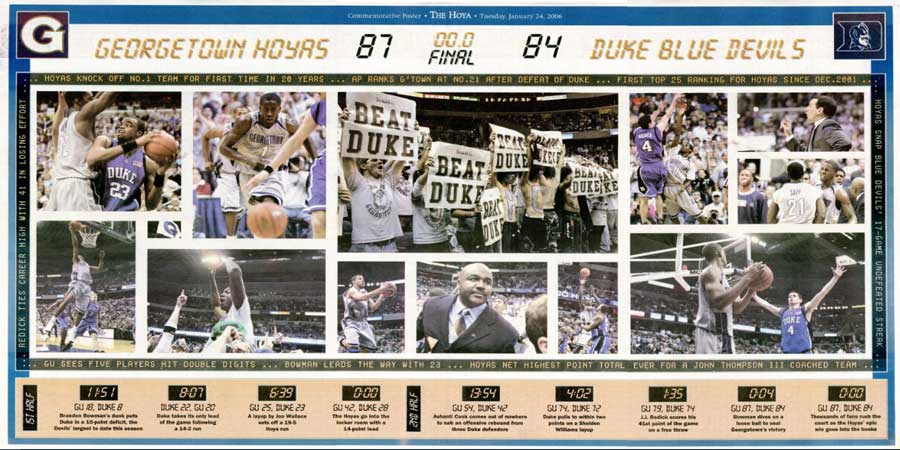
In one of the greatest games in school history, the Georgetown Hoyas shook the college basketball firmament with a 87-84 win over top ranked Duke before 20,035 at MCI Center Saturday.
This was not an outcome unduly affected by from fouls, from injuries, or an improbable shot at the buzzer. For forty minutes, Georgetown's patience and precision was stunning in its effect on the nation's #1 team, which entered the game with a 106-5 record against unranked non-conference opponents.
Entering the game averaging 15 points a game less than Duke, Georgetown could not get behind, and its early game efforts set the tone for what was to come. The Hoyas picked up two offensive rebounds in its first possession to take the lead, and forced three turnovers and three missed layups in the first three minutes of play. When Duke tied the game early at eight, two more turnovers and a pair of three pointers built back the lead, and when Brandon Bowman raced past the Blue Devils for a dunk with 12:31 in the 1st half, the Hoyas were up 10, 18-8.
Duke regrouped behind the play of senior All-America candidate J.J. Redick, who scored 10 of the Blue Devils' next 14 points in a run that gave Duke a 22-20 lead. With the Devils heating up, coach John Thompson III sat center Roy Hibbert, moved Jeff Green to the outside, and began a series of surgical strikes on the Duke interior defense that soon captured the nation's televised attention, as well as that of a wildly enthusiastic MCI Center crowd.
Following on the results North Carolina State had made on the Duke defense three days earlier, Green pulled the Duke defenses outside, and in a stunning fashion not unlike the Hoyas' 1989 denouement versus Princeton, the game changed.
Tied at 23, Jonathan Wallace went inside for a layup. Thirty two seconds later, Wallace picked up a second layup. On its next series, Green fed Darrel Owens for a layup. A rare J.J. Redick free throw miss set Green up to find Owens inside again, repeated 41 seconds later by Cook finding Green inside for two, 33-24. After Duke's fourth consecutive miss in a 3:31 run, Darrel Owens uncorked a long three pointer to send the MCI decibel meter into overdrive, 36-24 with 2:46 in the half.
Redick went back to work with an acrobatic three pointer, 36-27, part of his 18 point first half. But the Hoyas would not let Duke crawl back in, answering Redick's three with a thunderous Ashanti Cook three, 39-27, and three free throws to close out the half, 42-28. Georgetown had shot a torrid 66 percent from the field, held Duke to 40 percent shooting (6-11 for Redick, 4-14 for the rest of the team), and collected 14 assists on its 16 field goal possessions. It was as strong a first half from any Georgetown team in 20 years, but they would need even more in the 20 minutes to come.
Many in the MCI Center crowd were waiting for a patented Duke run, whereby the Blue Devils could erase a eight, ten or twelve point lead in a matter of a minute or two, possibly putting the Hoyas out of reach. But when would it come? The Devils did not open the half to help themselves, rushing three pointers and shooting 2 for 7 to start the half, whereupon Jeff Green scored the first six points of the Hoya half, 48-34. Redick answered with six points in 29 seconds to cut the lead to eleven, but Green wowed the crowd with a three to build the lead to 54-40.
Duke's offensive strategy began to shift. With Hibbert sitting and Green playing outside, the Devils began to drive to the basket, with some success. Greg Paulus (12 second half points, 14 overall) closed the gap to 10 with 11:03 to play, but the Hoyas answered with the inside shots once again, with two layups in 25 seconds to go up 64-52 midway through the half.
Duke began then to pick up points at the free throw line, with five of its next seven points coming from the line. The Hoyas hit a brief cold streak, going 1-5 from the field as Redick's free throws finally cut the lead to single digits with 7:43 to play. With Georgetown also entering the bonus, Georgetown hit two big one and one attempts to hold the lead at 70-61 with 6:15 to play, then watched both schools pick up its defense, with no scoring on either side until a Brandon Bowman breakaway with 4:49 to play, 72-63. A Redick three pointer and a steal off the next Georgetown possession cut the lead to 72-68 to play, eliciting the only sustained cheers audible from the 3,000 Duke fans perched in the higher reaches of MCI Center.
On its next series, with Duke crowding the baseline for an interception, Georgetown went deep, with Wallace tossing the ball over the Duke defenses to Brandon Bowman for the dunk, 74-68. The play was answered eight seconds later by a Redick drive, 74-70, and off a bad pass, Duke closed to 74-72. Again, Georgetown went deep, as Owens answered with an strike to Wallace, 76-72 with 3:54 left.
The defenses stood tall in the next group of possessions, with four consecutive turnovers between the teams. With 2:19 to play, Georgetown turned the ball over in its backcourt, and Redick, with 39 points, went to work, but missed badly on a three point attempt with 2:14 to play, and off the rebound Green passed long to Owens for the dunk, 78-72, sending Hoya fans skyward once again.
Still more twists and turns were to come. Off a Greg Paulus turnover, Jeff Green was fouled. After the Hoyas had gone 8 for 9 from the line in the second half, fatigue set in on the line. Green made one of two shots, 79-72, answered by two free throws by Redick, 79-74. It was to be Redick's last points of the game.
Green was sent back to the line with 1:27 to play and split the two again, 80-74, but Redick missed a close-in shot with 1:22 to play that could have cut the lead to one possession. Off the rebound, Bowman drove the court for a dunk, 82-74. The Hoyas looked to be pulling away, but as Redick cooled, Sean Dockery emerged. Dockery had scored two points all game, but accounted for eight of the Devils' final ten points, picking up a quick two with 1:04 to play and forcing a Bowman turnover deep in GU territory for another quick score, 82-78. The Hoyas were 48 seconds from a big win, but Duke's defensive pressure off the ball was really hurting its chances.
Off the inbounds, Cook was fouled but the free throw woes continued. Cook missed the first, then picked up the all important second, 83-78. Duke looked back to Redick in the corner for a three, but Bowman came up with a big block to gain possession for Georgetown with 0:29 to play. Bowman hit both free throws, 85-78.
Duke wasted no time, slicing through a porous GU interior defense in just three seconds for an uncontested basket, 85-78. Off the inbounds, Ashanti Cook lost control of the pass and Greg Paulus collected an easy layup, 85-82. Fouled off the ball, Bowman made one of two from the line with :16 to play, and Dockery answered with what looked like a three point shot that was correctly ruled a two pointer, 86-84, with just :09 to play.
On the next series, it was Wallace who was quickly fouled. With the game on the line, Wallace made the first free throw, but his second shot rolled around the rim and out, giving Duke an improbable last chance to tie the game. Racing down the floor, Paulus was stripped by Wallace, and Bowman covered the ball as the clock ran out and an estimated 2,000 students ran in, setting off wild celebrations throughout the arena and out onto 7th Street, where fans who had not able to get inside had watched it on a large video monitor.
Following handshakes between the teams' coaches, Georgetown coaches Thompson and Burke raced off the floor amidst the crowds. With Big East commissioner Mike Tranghese and former Georgetown athletic director Frank Rienzo not far away, former coach John Thompson stood at the tunnel entrance, with a hug for each player as they made their way back. Asked about his embrace with his son, the elder Thompson said "I love my child. After all he's had to go through, he deserves this."
With a leg cramp, Cook was helped to the tunnel by Patrick Ewing, Jr., while sophomores Hibbert, Wallace, and Green stayed among the student crowd, earning Hibbert the front page of the Post's Sunday sports section.
Georgetown's effort for the game is already becoming the stuff of legend. Facing a team which had held opponents to just 62 points a game and not allowed more than 75 in any one game this season, the Hoyas scored more points (87) than in any game in the John Thompson III era. Of its 24 possessions, 16 were by assist. Facing a team which had scored 70 more three pointers than its opponents this season, Duke was held to just nine of 19 attempts.
Five Hoyas scored in double figures. Bowman led all Georgetown scorers with a tremendous 23 point effort, none more so than that those pair of free throws late. Jeff Green not only scored 18 points, but led the team with assists with seven. Ashanti Cook (17 points) and Jonathan Wallace were exemplary in the backcourt, combining for 10 assists. After missing his first shot, Darrel Owens went 6 for 7 and scored 13. Holding All-America candidate Shelden Williams to 2-8 shooting and just four points overall, the Hoyas scored 50 points in the paint.
Georgetown's efforts do not detract from what was a supreme individual performance from Duke's J.J. Redick. His 41 points (12-24 FG, 6-11 from three, 11-13 from the line) is the fourth most ever by a Georgetown opponent, tying Howard's Ron Williamson's 41 point effort in the 2000-01 season. Redick accounted for nearly half Duke's points, six of its nine threes, and 11 of its 15 free throws. After the game, Duke coach Mike Krzyzewski noted that "when we don't match another team's intensity -- that doesn't happen very often, then all of a sudden we do J.J.-watching, where we're watching J.J. play. We might as well get tickets and sit behind the bench."
Krzyzewski praised Thompson and the team for their efforts. "Just what a superb performance," he said. "They were so deserving. If you get beat, you want to get beat by people who earn it, and they earned it."
For a generation of students who have only read about the NCAA tournament instead of living it, who were not even alive when Georgetown earned five Final 8 appearances in eight seasons, or who suffered through a litany of late game collapses at MCI Center in prior years, the outcome was cathartic. Yet, the team was especially proud of the students' efforts to put some life into the Hoyas' rented home. "It was terrific," said Thompson. "The energy you get off your fans definitely helps how we play, it gives our guys a boost. The students have been great for two years now."
And even as more important conference games await, positive signs appear ahead. "This Princeton offense is taking hold," said Thompson, who ended a run of losses to #1 ranked opponents that stretched nearly 21 seasons and becomes the part of the first father and son ever to each upset #1-ranked teams.
"Are we better at it than we were at this point last year? Yes."
"Are we a long way from where we are going to be? Yes."
Comments flowed from what was still a pre-Twitter media landscape:
"In the giddy moments after the game, the student sections behind each basket looked like a disaster zone, with toppled chairs and squashed cups," wrote Camille Powell at the Washington Post. "The arena floor was mobbed with dancing and screaming students. Redshirt forward Patrick Ewing Jr. picked up Cook, whose legs were cramping, and carried him through the crowd. Bowman stood on top of the scorer's table and screamed, and then appeared to stop and to hug every fan he came across as he walked off the floor."
"Clean-up crews at the MCI Center already had their hands full all afternoon, trying to prepare the building for a hockey game just a few hours after it had played host to a basketball game," wrote Brian Strickland of the Durham Herald-Sun. "But thanks to what had happened earlier in the afternoon, workers' hands also were filled with broken folding chairs, cell phones headed for the lost-and-found and piles of debris on the hardwood itself -- all telltale signs of a Duke loss away from home."
"Let's see, Georgetown knocks off the No. 1 team in the country. St. John's beats two ranked foes in the span of five days. Break out the Miami Vice shades and the Wham cassettes, baby -- it's 1985 all over again," said Stewart Mandel at Sports Illustrated.
"Georgetown has a history of being tough on devils and on Saturday its team exorcised the Duke Blue Devils, casting them from the ranks of the undefeated," wrote Ned Barnett at the Raleigh News & Observer. "Near the end of Duke's first defeat, a Georgetown student held up a sign declaring: "God is on our side." God made no postgame comment."
And from the Duke Basketball Report:
"One of the things Duke fans don't get to do anymore, and really haven't been able to do since 1991, is to thoroughly enjoy the role of underdogs. Don't get us wrong, it's better to win than for winning to be a surprise. But when you see the joy at a Georgetown, or a Virginia Tech, or whoever it happens to be who knocks Duke off, it's hard not to appreciate it and to be happy for that team. And we are sincerely happy for Georgetown and especially for Coach Thompson, a young coach who we have followed since he turned in a very impressive stint at Princeton. It's his biggest win so far, but it's not going to be his last one."
A photo from that day graces the cover of this site. I sometimes look at the faces in this photo, a moment in time. Where are they today?
One of the earliest contributions to this history site comes from a 2007 commentary titled "Team Moderate Temperature", by John Hawkes, a 2004 SFS grad who followed the story of a group of undergraduates who slept outside MCI Center the night before the game. It tells the story not only of the students, who are now in their early 40s, but the pulse of a fan base no longer present. In it, he wrote:
"What basketball does for the Georgetown campus at its best is bring students of all backgrounds, interests, and social circles together for one common purpose. A successful basketball team brings ever more people into the fold, and that can only be a good thing for the University as a whole. The significance of the Duke victory is that it created, in the words of Michael R. Segner, a "watershed moment of self-realization and pride, not just about our basketball team but the greatness of Georgetown as a whole"... The continuing relevance of the Duke victory today is that nearly every student on campus is more likely to believe that such a moment can always be waiting at the next game."
J.J. Redick, now the head coach at the NBA's Los Angeles Lakers, still remembers.
Raptors are in town and Kobe dropped 81 points on them on a January Sunday in 2006
— Law Murray ?? (@LawMurrayTheNU) January 19, 2026
The day before, JJ Redick dropped a career-best 41 points in Duke's first loss of that season
Asked JJ about that particular weekend in basketball history pic.twitter.com/jF4XfAE4Nj
I reached out twice to John Hawkes for him to provide a look back at this moment, 20 years later. No response. He checked out of Georgetown basketball, like most of his contemporaries -- pushed out, gave up, or simply ignored. I thought of these faces in the photo, many approaching their 20th reunion year, as Georgetown battled #3 Connecticut to a 64-62 loss this past weekend. Were they watching? Do they care anymore?
Twenty years later, the Duke game is remembered as much for nostalgia than for continuing success, and it's likely today's students will never get such an experience at a Georgetown basketball game.
There are no bottle rockets anymore at Georgetown. But for that one afternoon, the sky was the limit.