Back To The Future
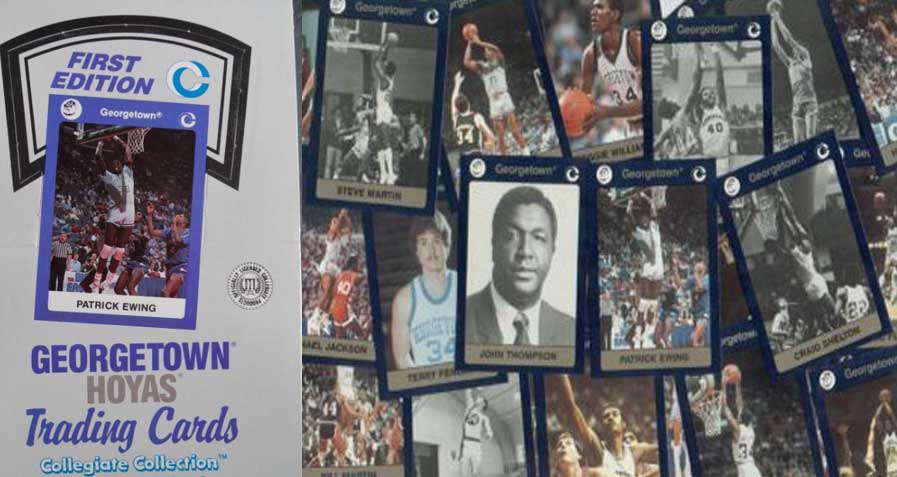
Earlier this summer, a Georgetown fan page on Facebook posted a series of online vignettes titled "Cold Case", asking if readers remembered a often mysterious former player. Some were more obvious than others, but each had enough clues to reach a conclusion. As with many things Georgetown, some cases are a little more complicated to close, and so it is with a long-forgotten idea that was (almost) a prelude to the era that now dominates college sports.
In 1991, a company introduced a series of trading cards featuring current and former Georgetown basketball players. A year later, it was out of the business altogether and by 1994 was defunct. What happened?
Trading cards are, at its core, collector's items. Their value is what the collector assigns to it.
The first trading cards appeared at the end of the 19th century, with a less than noble sponsor: tobacco companies. In one of its earliest marketing efforts, companies included cardboard images of baseball players as its new brands of cigarettes were introduced in the marketplace. Players were paid $10 to be included, and kids were said to congregate outside cigar shops asking for customers to hand them the cards as they left the store. A 524-player collection by the American Tobacco Company is among the most notable of that era in that one player, future Hall of Famer Honus Wagner, rejected the offer and forced them not to use his card in the campaign. Less than 100 of the "Wagner T-206" cards exist, with a recent sale of a card topping $5 million.
Companies also offered what were known as "tobacco silks", a postcard sized piece of artwork made of satin or silk, redeemable with proofs of purchase to the tobacco manufacturer. The fabric was of good quality, suitable for framing or even for quilting, and included a small but noticeable reference to its sponsor at the bottom of the silk. (Some suggest it was a tacit attempt for these companies to market to women at home.) Some of the silks were colorful images from nature, flags, or Indian chiefs. Some were even college athletes. Georgetown was among a number of schools who were featured in the tobacco silks, with generic images of young men representing the popular sports of the day: football, baseball, track, and the like. In the early 1900s, basketball was still relatively unknown.
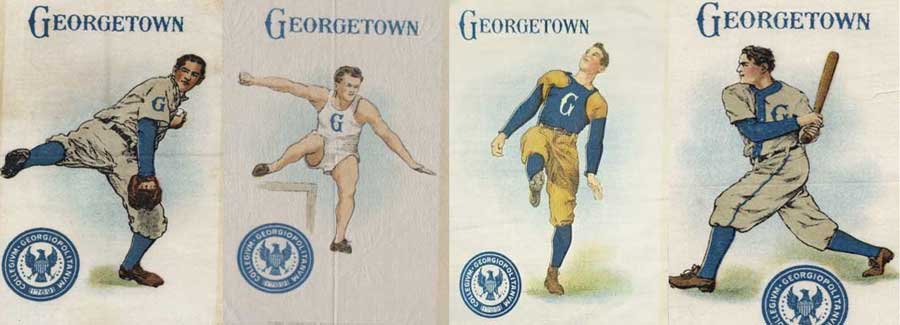
Tobacco use in the United State skyrocketed after World War I, and at that point the companies didn't see a need to offer premiums to drive its sales. The silks quickly disappeared, while trading cards, at least in its initial form, went dormant for much of the next two decades.
The cards returned under a new sponsor: chewing gum companies, who included cards of baseball players with a stick of gum, with an eye on reaching younger fans eager to collect a Mickey Mantle or a Ted Williams card. From 1956 to 1980, the Topps Gum Co. held a virtual monopoly on the market, signing nearly every major leaguer to a contract, offering around $125 a season, to produce cards with their images. Additional compensation might go to teams or even the players union if there was a dispute, but the real money for Topps was in the sale of gum, not the cards themselves.
The hobby changed in the 1980s, as kids who were card collectors in their youth were now young men with nostalgia, and disposable income. Aided by James Beckett, a college professor who published a price guide to old baseball cards, rare cards could now be traded as an investment much like rare coins, and interest boomed. Interest in cards for sports such as the NFL and NBA soon followed. A Michael Jordan NBA rookie card can now be sold between $20,000 and $450,000, depending on the quality of the card, much like a rare coin is judged.
It didn't take long before someone saw the college sports market as an opportunity to ride the wave of interest in collectibles.
In 1988, a Louisville businessman named Dennis H. Disney founded a company called Collegiate Collection, Inc., located across the street from a commercial printer in the Phoenix Hill section of Louisville. Extant records do not display the company's annual sales, only that its annual report was submitted.
In 1990, Collegiate Collection debuted its product: a 100-card series of sports trading cards featuring current and former players of various schools to which it had agreements with Arizona, Arizona State, Clemson, Michigan State, Louisiana State, North Carolina, Notre Dame, and UCLA. The design of the card followed that of pro sports cards: the player's photo on the front, his statistics and relevant information on the back. Individual packages contained eight cards and were sold to collectible shops in boxes of 24 packages for a wholesale cost of $35.64 per box, whereupon the stores could price the individual packages as demand warranted. As was the case with baseball cards, a fan wouldn't know which cards he bought until he opened the package.
As to the success of its first series of schools (which coincidentally, did not include the University of Louisville nor the University of Kentucky), it's a cold case. References to "Collegiate Collection", "trading cards", "football cards" or "basketball cards" do not appear in online searches in the local or the campus press at these schools in 1989 or 1990. In an industry dominated by three major collectibles companies producing tens of millions of cards a year, Collegiate Collection didn't make much of an impact in its first year of production. The next year, it added seven more schools, and one of these was Georgetown.
The 1980s were a busy time for Georgetown athletic marketing. Taking advantage of the growing national interest in the team and in head coach John Thompson, Rienzo sought to market the Hoyas nationwide through a firm known as the Collegiate Licensing Company or CLC. The CLC was a clearinghouse for companies interested in selling items with a college name and/or logo on it. Rather than having a manufacturer or distributor negotiate with dozens of different schools for each product, the manufacturer would get legal clearance from CLC, who would then remit royalties to the schools.
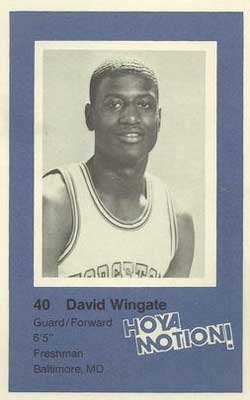
Trading cards were not new to Georgetown. Beginning in 1982, Georgetown produced a series of trading cards of its own, first dubbed the "Hoyamotion" cards and later "Kids & Cops". These were cards depicting Georgetown players on one side and a message on the back encouraging kids to exercise good behavior. The cards were distributed to kids by local public safety officers: if a child collected the set, he or she could receive two free tickets to a Georgetown game. It was the kind of community relations that coach John Thompson appreciated, and the cards were issued through the 1996-97 season.
Members of the team received no compensation for these cards--for one thing, they were free and meant to serve a charitable purpose. Players of this era also waived rights to receive compensation for photos or videos of them playing the sport; for example, Patrick Ewing or Alonzo Mourning had no rights to a share of Georgetown's NCAA TV revenues even if they were in the broadcast itself. Players in the 1980s had waived rights to the use of their images, but for players who competed before the age of national TV, particularly those that predated the Big East, no such waiver likely existed. While Georgetown had not marketed products that specifically named players, consideration for what is now known as "name, image, and likeness" did not exist in commercial law.
It appears that each school had the freedom to include any 100 players and coaches it so chose: some schools stayed with one sport, while others offered a variety of athletes across numerous sports such as football, baseball, and track and field. Georgetown's card list would be all basketball, with a mix of former and current players dating back to the 1950s, supplying Collegiate Collection with media guide-quality photos for the front of the card and statistics for the back. The packages themselves clearly noted "information on cards provided by Georgetown University".
It also contained, perhaps by accident, a rare team photo of the 1981-82 Hoyas. In it, freshman Patrick Ewing is wearing a different jersey number; the photo was retaken once he was issued #33.
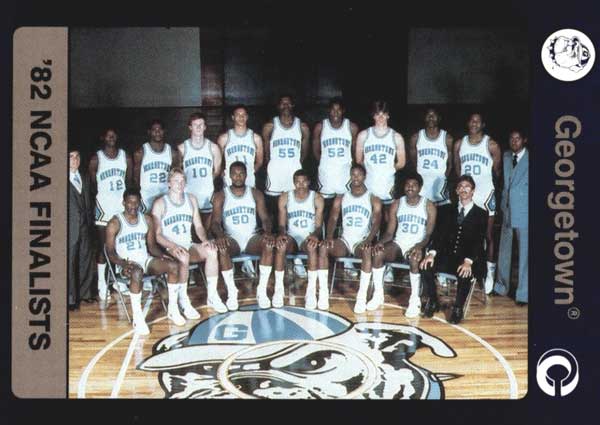
As word spread among those to be featured on the Georgetown cards, some former players raised an inconvenient but seminal question: are we being compensated for this?
Georgetown had a problem. Collegiate Collection had an even bigger problem.
Realizing the issue at hand, Georgetown terminated the contract with Collegiate Collection. In learning of Georgetown's decision, Collegiate Collection likely understood the risk position it had taken: hundreds of thousands of cards were being produced with former athletes who might seek royalties from their school or, by extension, Collegiate Collection. As some of the participating schools included cards from former athletes turned entertainers (musician Garth Brooks, actor Burt Reynolds, and golfer John Daly, among others), they could easily employ attorneys to bring a restraining order if they chose to do so. Estates had an even more complex relationship relative to selling a product featuring a decedent, such as a trading card featuring the late Jackie Robinson, who played four sports at UCLA. Without case law to the contrary, Collegiate Collection could be held liable as the producer of the product.
Whether by liability, lower than anticipated sales, or both, the college card series was suspended nationwide. Collegiate Collection pivoted to a series of trading cards on the Indy 500, without much success. In 1994, the Commonwealth of Kentucky dissolved its corporate charter for failing to file an annual report. The warehouse that hosted the company was eventually razed and stands as vacant land today.
The Georgetown cards were never actually sold, but thousands of copies exist, the result of cards that were likely stored and then forgotten in a shipping warehouse. Cards and boxes, none with a printed list price, have been offered on eBay for years, with auctions going for as little as $1.00 each for cards and $7.95 for boxes. The value of a Georgetown card in the collectors' world, absent an autograph from John Thompson or Patrick Ewing, is minimal.
Among millions of sports cards produced during what is derisively known as the "junk wax" era of collectibles, the Collegiate Collection has little or no visibility in collecting circles. An editor at one of the leading sports collectible publications noted that "I'm aware of the set but don't really have any knowledge of it or the company that made them." CLC, the company that facilitated the original deals, did not return a request for comment.
An online archive of the 1991 Georgetown cards is found at this link.
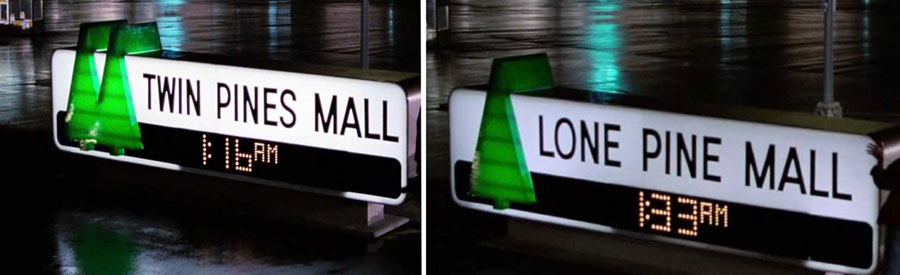
In case you are wondering what these images are about, first, a little back story.
Fans of the 1980s trilogy "Back To The Future" spotted this easter egg in the first movie: Marty McFly prepares for his time-traveling journey in the parking lot of the Twin Pines Mall, but upon arriving in 1955 he inadvertently crashed into a small tree outside of town. Upon his return to 1985, the mall sign now reads "Lone Pine Mall", a sly nod to the theory that any change in the past can alter the future in unexpected ways.
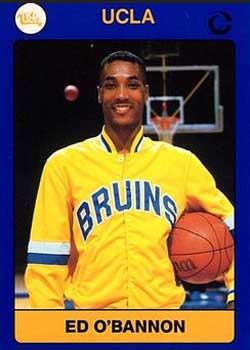
One of these college players was Ed O'Bannon, a former national high school player of the year, who was featured in the 1990 and 1991 UCLA card collections. Eighteen years later, O'Bannon was a retired NBA veteran who noticed his likeness appearing in an EA Sports video game. O'Bannon was never contacted to authorize or license his likeness for the game. He agreed to the the lead plaintiff among a group of 20 former college players (including Oscar Robertson and Bill Russell) in a case against unauthorized use of the players' name, image, and/or likeness in the video game. A district court extended O'Bannon's claim to a class-action suit for current and former players. The judge, Claudia Wilken, found for O'Bannon as what one web site called "an unreasonable restraint of trade in violation of antitrust law."
"The gravamen of O'Bannon's complaint was that the NCAA's amateurism rules, insofar as they prevented student-athletes from being compensated for the use of their NILs, were an illegal restraint of trade under Section 1 of the Sherman Act, 15 USC, section one," wrote the U.S. Ninth Circuit Court of Appeals in a 2015 decision. This was appealed by the NCAA to the Supreme Court but ultimately denied, which served to uphold a $42 million judgment.
The O'Bannon case was a precursor to NCAA v. Alston, the landmark 2021 decision on athlete rights that was upheld in a rare unanimous decision of the United States Supreme Court.
"To be sure, the NCAA and its member colleges maintain important traditions that have become part of the fabric of America: game days in Tuscaloosa and South Bend; the packed gyms in Storrs and Durham; the women's and men's lacrosse championships on Memorial Day weekend; track and field meets in Eugene; the spring softball and baseball World Series in Oklahoma City and Omaha; the list goes on," wrote associate justice Brent Kavanaugh in a concurring opinion. "But those traditions alone cannot justify the NCAA's decision to build a massive money-raising enterprise on the backs of student athletes who are not fairly compensated. Nowhere else in America can businesses get away with agreeing not to pay their workers a fair market rate on the theory that their product is defined by not paying their workers a fair market rate. And under ordinary principles of antitrust law, it is not evident why college sports should be any different."
Would a legal case in the 1990s over O'Bannon's appearance on a trading card have changed the trajectory of NIL, perhaps under a different jurisdiction and a much different Supreme Court? Or would the tidal wave of NIL have simply overtaken college sports 30 years sooner? There's no way to tell, of course, unless one went back in time.
Thirty-five years later, the trading cards are a reminder of an age of uncertainty in college sports, one which carries to this day.